

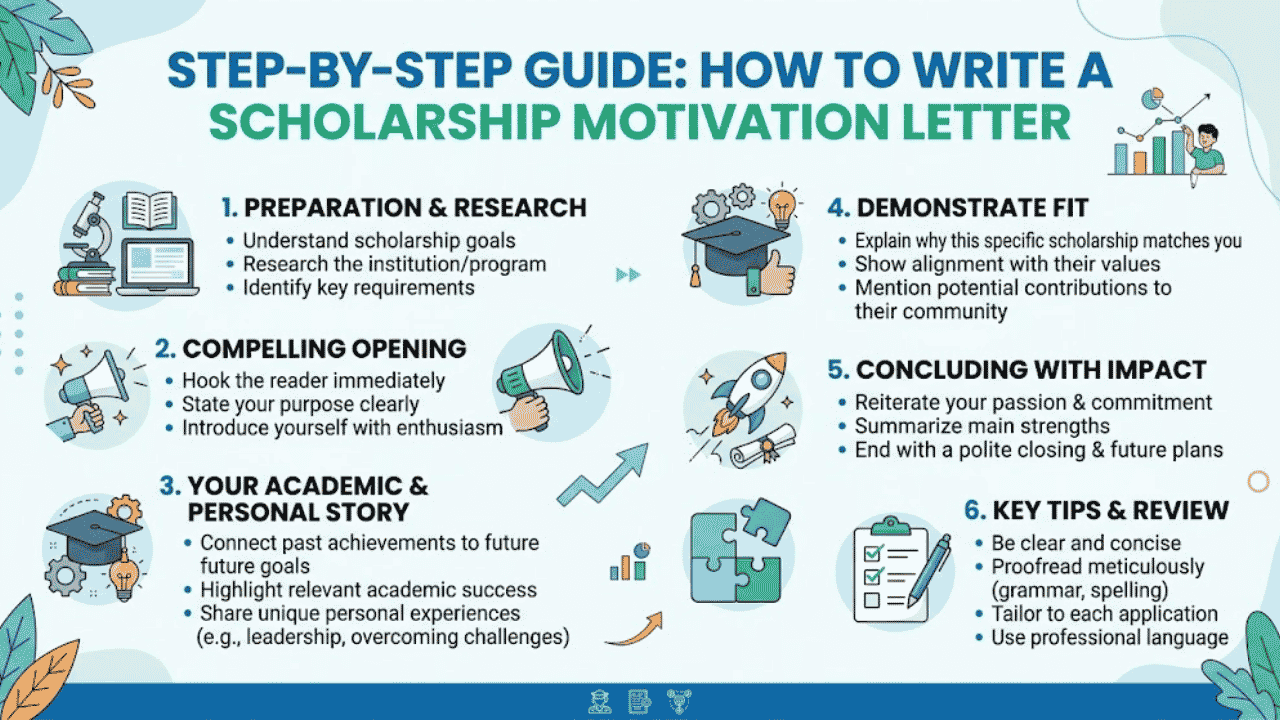
A scholarship motivation letter (also called a statement of purpose, personal statement, or letter of intent) is often the most influential part of your application. Grades and test scores show what you’ve achieved. Your letter shows who you are, why you want this opportunity, and what you’ll do with it. Selection committees read hundreds of applications, and a well-crafted letter is frequently what separates finalists from everyone else.
This guide walks you through the entire process, from understanding what committees want to polishing your final draft.
What Is a Scholarship Motivation Letter?
A motivation letter is a one-page (sometimes up to two-page) document in which you explain:
- Why you are applying for this specific scholarship and program
- What experiences, skills, and values qualify you
- What your academic and career goals are
- How the scholarship will help you achieve them
- How you’ll contribute to your community, field, or the scholarship’s mission
It is not a résumé in paragraph form, and it is not a plea for charity. It is a persuasive, personal argument that you are a worthwhile investment.
Motivation letter vs. personal statement vs. cover letter
| Document | Focus | Typical length |
| Motivation letter | Why this scholarship/program, future goals, fit | 1 page (400–700 words) |
| Personal statement | Your life story, character, and growth | 500–1,000 words |
| Statement of purpose | Academic/research goals, especially for graduate study | 1–2 pages |
| Cover letter | Job applications, with a professional focus | 1 page |
Always check the scholarship’s instructions. Some use these terms interchangeably, and the specific prompt matters more than the label.
What Selection Committees Look For
Understanding the reader helps you write for them. Committees generally evaluate:
- Clarity of purpose. Do you know what you want and why?
- Fit. Do your goals align with the scholarship’s mission and the program offered?
- Evidence of ability. Have you demonstrated achievement, resilience, or potential?
- Impact. Will you use this opportunity to benefit others, not just yourself?
- Authenticity. Does the letter sound like a real person, not a template?
- Communication skills. Is it well organized, clear, and error-free?
Keep these six criteria in mind throughout the writing process.
Before You Write: Preparation
Step 1: Research the scholarship thoroughly
Read the scholarship’s website, mission statement, eligibility criteria, and past winners’ profiles. Note:
- The organization’s values (leadership, service, innovation, academic excellence, etc.)
- Keywords repeated in the description
- Any specific essay prompt, word limit, or formatting rule
Step 2: Research the program and institution
Identify specific professors, courses, research labs, facilities, or initiatives that attract you. Generic praise like “your university is prestigious” is weak. Specifics like “Professor Rahman’s work on drought-resistant crop genetics aligns with my thesis on…” are strong.
Step 3: Self-reflection
Before drafting, answer these questions in rough notes:
- What moment or experience sparked my interest in this field?
- What are my three most significant achievements, and what did each teach me?
- What challenges have I overcome, and how did they shape me?
- What are my short-term (1–3 years) and long-term (5–15 years) goals?
- Why do I need this scholarship specifically?
- How will I give back?
Step 4: Choose your core theme
The best letters have one unifying thread, such as a passion for public health, a commitment to educational access, or a fascination with renewable energy. Everything you include should connect to that theme. If a detail doesn’t support it, cut it.
The Ideal Structure
A strong motivation letter follows a logical flow. Here’s a reliable structure:
Header and Salutation
Include your name, contact information, the date, and the recipient’s details if known. Address the committee by name if possible (“Dear Dr. Ahmed and Members of the Selection Committee”). If not, use “Dear Scholarship Committee” or “Dear Members of the Selection Panel.”
Paragraph 1: The Hook and Introduction (about 10–15%)
Open with something that grabs attention and establishes your purpose. Options include:
- A brief, vivid anecdote that sparked your passion
- A striking fact or question tied to your field
- A clear statement of your mission
Weak opening: “I am writing to apply for the XYZ Scholarship because I want to study engineering.”
Strong opening: “When the floods of 2022 swept away my village’s only bridge, I watched my neighbors rebuild it with ropes and bamboo, and I decided I would learn to build it better.”
Then clearly state what you’re applying for and your core motivation.
Paragraph 2: Your Academic and Professional Background (about 20%)
Highlight relevant accomplishments, not everything you’ve ever done. Focus on:
- Academic performance and relevant coursework
- Research, projects, internships, or work experience
- Awards or recognition
Use specific details and numbers where possible. Show what you learned and how you grew, not just what you did.
Paragraph 3: Extracurricular Activities, Leadership, and Character (about 15–20%)
Demonstrate leadership, teamwork, initiative, and service. Volunteering, community projects, clubs, and mentoring all count. Quality beats quantity: one deeply described experience is more persuasive than a list of ten.
Paragraph 4: Your Goals and Why This Program (about 20–25%)
Connect your past to your future. Explain:
- Your short-term and long-term goals
- Why this particular program, university, or country is the right fit
- How it will bridge the gap between where you are and where you want to be
Paragraph 5: Why You Deserve This Scholarship and How You’ll Give Back (about 15%)
Explain the financial or opportunity gap honestly (without self-pity) and how the scholarship removes a barrier. Then show the return on investment: how you’ll use your education to benefit your community, country, or field.
Closing Paragraph (about 5–10%)
Reaffirm your enthusiasm and fit, thank the committee for their time, and end confidently.
Sign-off
“Sincerely,” or “Respectfully,” followed by your full name.
Step-by-Step Writing Process
Step 1: Brainstorm and outline
Map your notes onto the structure above. Write one sentence for each paragraph summarizing its purpose.
Step 2: Write a messy first draft
Don’t aim for perfection. Get your ideas on paper without editing. Write as if explaining your story to someone you respect.
Step 3: Show, don’t tell
Telling: “I am a hard-working and dedicated leader.”
Showing: “As president of the debate club, I increased membership from 12 to 45 students by launching a peer-mentoring program, and our team qualified for nationals for the first time.”
Concrete evidence is far more convincing than adjectives.
Step 4: Use the STAR method for key stories
Structure your examples as:
- Situation: What was the context?
- Task: What was your responsibility or challenge?
- Action: What specifically did you do?
- Result: What was the outcome, and what did you learn?
Step 5: Revise for focus and flow
Cut anything that doesn’t serve your central theme. Ensure each paragraph transitions smoothly to the next. Check that your opening and closing connect, since circling back to your opening image or idea creates a satisfying frame.
Step 6: Edit for style and length
- Respect the word limit strictly
- Use active voice (“I led the project,” not “The project was led by me”)
- Vary sentence length
- Replace vague words (“many,” “very,” “a lot”) with specifics
- Remove clichés (“ever since I was a child,” “make the world a better place”)
Step 7: Proofread carefully
Read it aloud, read it backward sentence by sentence, and run spelling and grammar checks. Then ask at least two other people (a teacher, mentor, or native speaker) to review it.
Tone, Style, and Language Tips
- Be confident, not arrogant. Own your achievements without exaggeration.
- Be humble, not self-deprecating. Acknowledge help from others while claiming your own effort.
- Be sincere. Committees can detect insincerity and flattery.
- Be professional but personal. Formal structure, genuine voice.
- Be positive. When discussing hardship, focus on resilience and growth rather than complaint.
- Keep it simple. Clear, direct language beats complicated vocabulary. Never use a word you wouldn’t use in conversation just to sound impressive.
Common Mistakes to Avoid
- Using a generic template. Sending the same letter to multiple scholarships is easy to spot and usually fails.
- Repeating your CV. The committee already has your résumé; add what it can’t show.
- Writing about what the scholarship can do for you only. Balance your needs with your contributions.
- Being vague about goals. “I want to help people” is not a plan.
- Excessive sob story. Share hardship honestly, but pair it with agency and achievement.
- Ignoring the prompt or instructions. Wrong length, format, or off-topic content can disqualify you.
- Grammar and spelling errors. They signal carelessness.
- Name or institution errors. Leaving in the wrong scholarship name from a previous application is a classic, costly mistake.
- Overly long or rambling paragraphs. Respect the reader’s time.
- Negative comments about others. Never criticize former teachers, schools, or countries.
- Clichés and exaggeration. “Passionate” and “dream” are overused; prove them instead.
- Last-minute writing. Great letters need multiple drafts over days or weeks.
Formatting Guidelines
- Length: Usually one page (350–700 words), unless otherwise specified
- Font: Times New Roman, Arial, or Calibri, size 11–12
- Margins: About 1 inch (2.5 cm) on all sides
- Spacing: Single or 1.15 line spacing, with a blank line between paragraphs
- Alignment: Left-aligned
- File type: PDF unless another format is requested
- File name: Professional and clear (e.g., “Ayesha-Khan-Motivation-Letter.pdf”)
Sample Motivation Letter
[Your Full Name]
[Address] | [Email] | [Phone]
[Date]
[Committee Name]
[Scholarship Name]
[Address]
Dear Members of the Selection Committee,
When the 2022 floods destroyed the only bridge connecting my village to the nearest town, I watched my neighbors rebuild it with bamboo and rope. It held for three months before the next rain washed it away. That experience convinced me that communities like mine don’t lack determination; they lack engineering solutions designed for their realities. I am applying for the Global Future Leaders Scholarship to pursue a Master’s in Civil and Environmental Engineering at the University of Melbourne, so I can build resilient infrastructure for flood-prone regions.
During my Bachelor’s in Civil Engineering at the University of Engineering and Technology, Lahore, I graduated in the top 5% of my class with a CGPA of 3.8/4.0. My final-year project, a low-cost modular drainage system for rural settlements, won first place at the National Student Innovation Fair. Working with a team of four, I led field surveys across three flood-affected districts, and the experience taught me that technical design must begin with listening to the people who will use it. Afterward, I interned for six months at a water management consultancy, where I contributed to flood risk assessments for two municipal projects.
Beyond academics, I founded “Safe Roads, Safe Villages,” a student initiative that has trained over 200 villagers in basic flood-preparedness and temporary shelter construction. Coordinating twenty volunteers and securing small grants from local businesses taught me leadership, budgeting, and perseverance when resources are limited.
The University of Melbourne’s program stands out because of its focus on climate-resilient infrastructure and its partnership with the Water Sensitive Cities research center. I am particularly drawn to Dr. Helen Carter’s research on community-based flood adaptation, which closely matches my own interests. After graduation, I plan to work with a development agency on regional flood-mitigation projects, and in the long term I aim to establish an engineering firm in Pakistan dedicated to affordable, climate-adaptive infrastructure.
I come from a family of modest means, and my parents’ income cannot cover international tuition. This scholarship would remove the barrier standing between my ambition and the training I need. In return, I commit to bringing my knowledge home: mentoring young engineers, sharing research with local governments, and expanding my initiative to more villages.
Thank you for considering my application. I would be honored to represent the values of this scholarship and to turn this opportunity into lasting impact.
Sincerely,
[Your Full Name]
Why This Sample Works
- Strong opening: A specific, memorable story, not a cliché
- Clear theme: Flood-resilient infrastructure runs through every paragraph
- Concrete evidence: Numbers, awards, and named projects
- Specific fit: Names the program, research center, and professor
- Honest need: Mentions finances briefly and without self-pity
- Return on investment: Clear plan to give back
- Confident close: Gratitude without begging
Adapting Your Letter for Different Situations
For undergraduate scholarships: Emphasize academic potential, curiosity, extracurriculars, and personal growth. Admissions readers understand you’re early in your journey.
For master’s or PhD scholarships: Emphasize research interests, relevant experience, methodology, and alignment with specific faculty or labs.
For need-based scholarships: Explain your circumstances honestly and factually, and focus on resilience and what you’ve achieved despite limitations.
For merit-based scholarships: Lead with achievements, leadership, and measurable impact.
For country- or region-specific scholarships (e.g., Chevening, Fulbright, DAAD, Commonwealth): Emphasize leadership potential, your plan to return and contribute to your home country, and cultural exchange. Study each program’s selection criteria closely, since they differ significantly.
For field-specific scholarships (STEM, arts, women in leadership, etc.): Tie your story directly to the field’s challenges and the scholarship’s mission.
Final Checklist
Before submitting, confirm that you have:
☐ Read and followed all instructions and the prompt
☐ Addressed the correct scholarship, institution, and committee name
☐ Opened with a compelling, specific hook
☐ Included concrete achievements with evidence and numbers
☐ Explained why this program and this scholarship
☐ Stated clear short-term and long-term goals
☐ Described how you will give back
☐ Maintained one unifying theme
☐ Stayed within the word or page limit
☐ Removed clichés, repetition, and filler
☐ Proofread multiple times and had others review it
☐ Saved it in the correct format with a professional file name
☐ Submitted before the deadline, ideally a few days early
Frequently Asked Questions
How long should a motivation letter be?
Typically 400–700 words or one page. Always follow the stated limit.
Should I mention my financial situation?
Yes, if relevant, but briefly and professionally. Focus on how the scholarship enables your goals rather than dwelling on hardship.
Can I use the same letter for multiple scholarships?
You can reuse your core stories, but customize the introduction, fit, and goals for each scholarship.
What if I have low grades?
Address it briefly and honestly if there’s a legitimate reason, then pivot to growth, improvement, and strengths such as experience, projects, or resilience.
Is it okay to use AI tools or templates?
They can help with brainstorming or grammar, but the content and voice must be genuinely yours. Committees value authenticity, and generic text is easy to spot.
How personal should I get?
Share what’s relevant to your goals and character. Be honest, but keep it professional.
Conclusion
A winning scholarship motivation letter is not about perfect prose or impressive vocabulary. It is about clarity, authenticity, and connection. Tell a focused story: where you come from, what you’ve done, where you’re going, and why this scholarship is the bridge. Back every claim with evidence, show genuine knowledge of the program, and make it clear that your success will benefit others too.
Start early, write multiple drafts, seek feedback, and let your real voice come through. Your letter is your chance to turn a stack of documents into a person the committee wants to support.
Good luck with your application!
